Brent Crude Hits $95, India Faces Higher Oil Import Bill
Brent crude crosses $95, India's oil import bill may rise. Higher costs could fuel inflation.
'%3E%3Crect%20width%3D'96'%20height%3D'96'%20fill%3D'%230B6E4F'%2F%3E%3Ccircle%20cx%3D'30'%20cy%3D'24'%20r%3D'44'%20fill%3D'%23fff'%20opacity%3D'.12'%2F%3E%3Ccircle%20cx%3D'60'%20cy%3D'74'%20r%3D'40'%20fill%3D'%23000'%20opacity%3D'.10'%2F%3E%3C%2Fg%3E%3Cg%20fill%3D'none'%20stroke%3D'%23fff'%20stroke-width%3D'3.2'%20stroke-linecap%3D'round'%20stroke-linejoin%3D'round'%3E%3Cpolyline%20points%3D'31%2C59%2041%2C49%2049%2C54%2063%2C37'%2F%3E%3Cpolyline%20points%3D'55%2C37%2063%2C37%2063%2C45'%2F%3E%3C%2Fg%3E%3C%2Fsvg%3E)
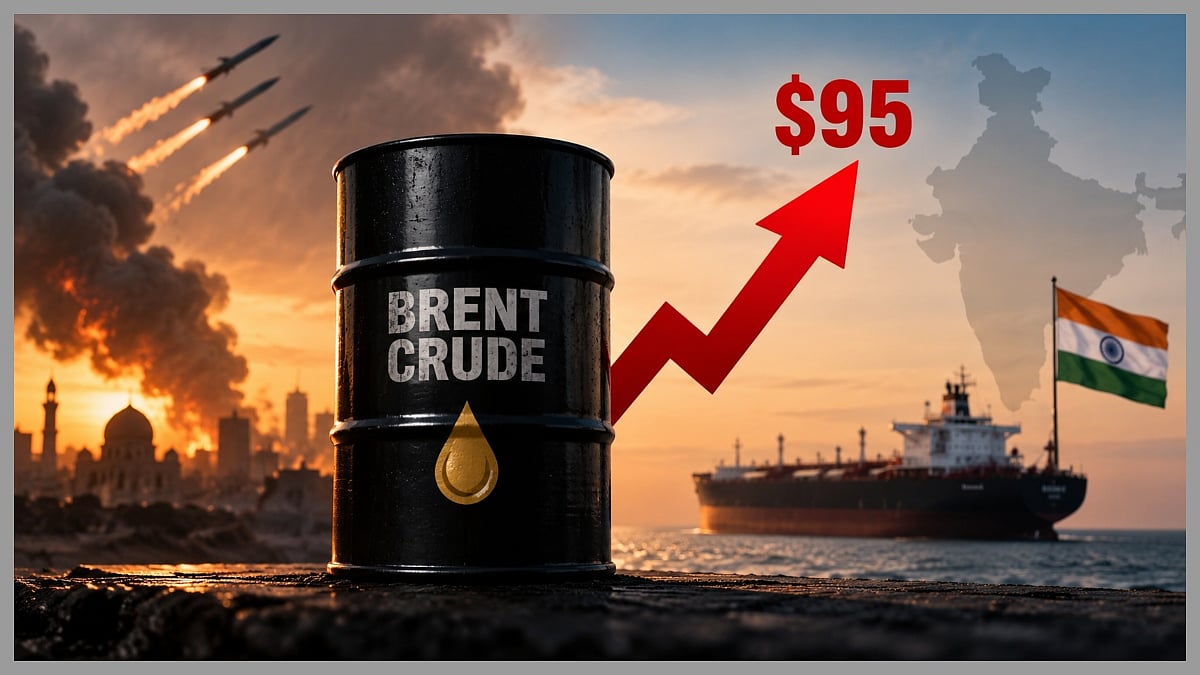
Brent crude oil prices have surged past $95 a barrel due to renewed fighting in West Asia, sparking fears of supply disruptions. This escalation has led to a 20% increase in prices since early July, reversing the brief decline seen during a period of calm. The rise in crude oil prices is expected to have a significant impact on India, which imports nearly 90% of its crude oil requirements.
The Indian economy is highly sensitive to global oil prices, with its oil import bill standing at around $123 billion in FY26. Every $1 increase in crude prices sustained for a year could add approximately Rs 18,000 crore to the annual bill. In the first four months of FY27, India imported crude worth $63.4 billion, up about 56.5% from a year earlier.
The supply routes from West Asia, which traditionally supplied 60-65% of India's crude imports, are under pressure. The closure of the Strait of Hormuz has sharply reduced oil flows, forcing Indian refiners to diversify towards Russia, the US, and Venezuela. While supplies remain available, longer shipping routes and the heavier nature of some crude grades increase processing and transport costs.
India's petrol consumption rose 7.88% year-on-year to 3.82 million tonnes in August, while diesel demand increased 6.46% to 7 million tonnes. Rising consumption will further lift import requirements, making India more vulnerable to fluctuations in global oil prices.
To mitigate this risk, India is pushing for energy security by sourcing oil from about 41 countries and seeking more suppliers. The Rs 84,000-crore Samudra Manthan offshore exploration scheme also aims to increase domestic production. India's eastern and western offshore basins are estimated to hold more than 5,600 million metric tonnes of oil-equivalent hydrocarbon potential.
The impact of higher crude oil prices on India's economy could be significant, with potential consequences including higher inflation, weaker growth, and a wider current account deficit. As the global oil market continues to be volatile, India will need to navigate these challenges to ensure energy security and minimize the impact on its economy.
In conclusion, the surge in Brent crude oil prices to $95 a barrel poses a significant challenge to India's economy, given its heavy reliance on imported oil. The government's efforts to diversify oil sources and increase domestic production are crucial steps towards mitigating this risk and ensuring energy security for the country.
The rise in crude oil prices is a reminder of the importance of energy security and the need for India to reduce its dependence on imported oil. As the country continues to grow and develop, it will be essential to find ways to manage the impact of fluctuations in global oil prices and ensure a stable and secure energy supply.
Overall, the increase in Brent crude oil prices to $95 a barrel is a significant development that will have far-reaching implications for India's economy. As the country navigates these challenges, it will be essential to prioritize energy security and find ways to minimize the impact of higher oil prices on the economy.
The Indian government's efforts to promote energy security, including the Samudra Manthan offshore exploration scheme, are crucial steps towards reducing the country's dependence on imported oil. By increasing domestic production and diversifying oil sources, India can reduce its vulnerability to fluctuations in global oil prices and ensure a stable and secure energy supply.
In the coming months, it will be essential to monitor the impact of higher crude oil prices on India's economy and take steps to mitigate any negative consequences. By prioritizing energy security and promoting domestic production, India can reduce its dependence on imported oil and ensure a stable and secure energy supply for the future.
The surge in Brent crude oil prices to $95 a barrel is a significant challenge for India, but it also presents an opportunity for the country to prioritize energy security and reduce its dependence on imported oil. By taking steps to increase domestic production and diversify oil sources, India can ensure a stable and secure energy supply and minimize the impact of fluctuations in global oil prices on the economy.
Frequently asked questions
How much of India's crude oil requirement is imported?
India imports nearly 90% of its crude oil requirement.
What is the estimated impact of a $1 increase in crude prices on India's annual oil import bill?
Every $1 increase in crude prices sustained for a year could add approximately Rs 18,000 crore to the annual bill.